
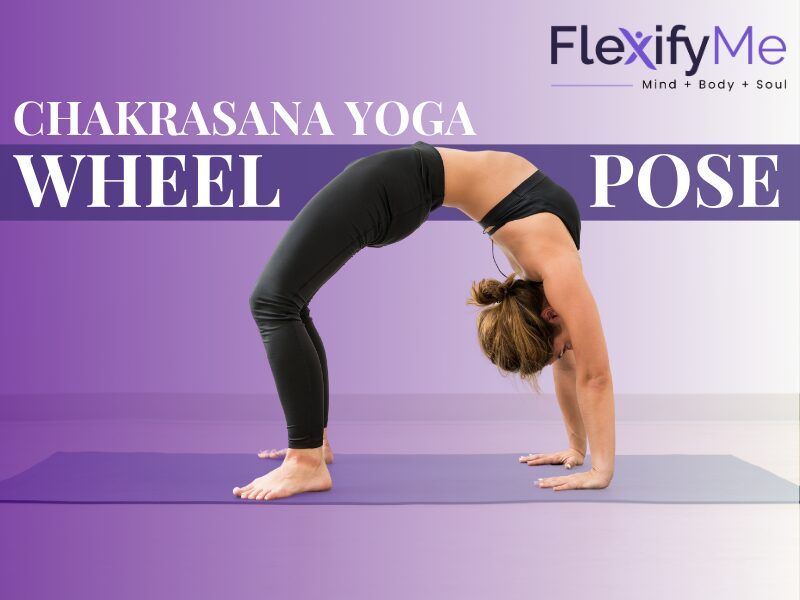

Chakrasana pose, or wheel pose, is also known as Urdhva Dhanurasana, where urdhva means “raised” and dhanur means “bow,” collectively meaning “raised bow” pose. It is an intricate pose involving an advanced backbend that opens your chest, shoulders, and hips. It is a high-spirited pose with numerous benefits that require considerable flexibility, strength, and stability.
The Chakrasana is part of the Hatha Pradipika yoga asana series. It has many modified versions designed to cater to different levels of flexibility, from beginner to advanced, which we will discuss further.
In this blog, we will understand how to do Chakrasana and also learn about its benefits and different variations.
How to do Chakrasana? Step-by-Step Guide
The Chakrasana pose requires you to form a rainbow structure. However, you need to go through the pose step by step. Let’s see how to do Chakrasana properly to get the most out of its benefits.
Step 1: Lie on your back with your knees bent and feet wide apart, flat on the floor, at a comfortable distance, such that your feet are accessible to your hands when extended.
Step 2: Now, keep your arms at your sides, palms facing the floor. And prepare your body for the pose.
Step 3: Slowly raise your arms extended to the ceiling, then bend your elbows and flip your palms, placing them near your shoulders with your fingers pointing towards your feet.
Step 4: Inhale as you press your palm and feet firmly onto the ground. Now, carefully lift your hip off the shoulder, keeping the crown of your head on the floor.
Step 5: Exhale, then lift your torso and hips slightly higher, straightening your arms and legs as much as possible and distributing your weight equally between your palms and feet.
Step 6: Tilt your head as far as feasible without forcing. Try to be there for five breaths.
Step 7: Now, gently come out of the pose by bringing your head to the neutral position and getting your upper and lower body onto the floor by bending your arms and knees.
Step 8: Before repeating, relax your body in savasana (corpse pose), then proceed with the next repetition or asana.
Chakrasana Benefits You Should Know About
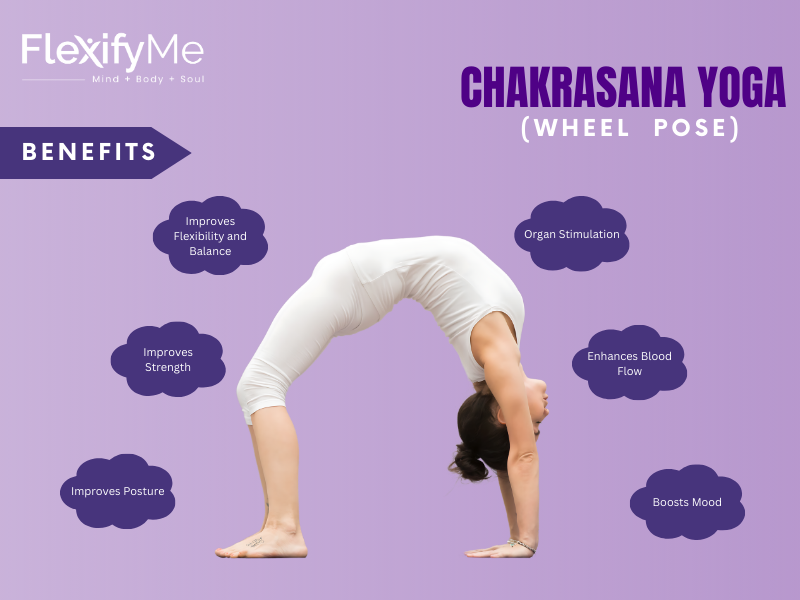
Like any yoga asana, the urdhva dhanurasana has numerous advantages beyond just spine flexibility, so let’s discuss the Chakrasana benefits.
Improves Flexibility and Balance
With the rigorous back bend and lengthening of the body, the Chakrasana pose helps improve spinal flexibility with regular practice. This backbend yoga pose involves synchronisation of various muscles, such as the arms, legs, core, and back, which helps improve coordination and translate into better balance.
Builds Strength
Engaging the core muscles, this wheel pose helps build strength in the arms, legs, shoulders and abdominal muscles. Practising this pose regularly contributes towards enhanced muscle endurance, a healthy spine and strong bone density.
Supports Better Posture
Like any other spine extension pose, Chakrasana also helps improve posture by encouraging proper spinal alignment, which is often compromised by poor posture and prolonged sitting. Hence, it helps maintain the natural curve of your spine, which helps combat back pain.
May Help Digestion
The wheel pose helps digestion by relieving issues like acidity, gas, bloating, and constipation, and improving appetite. Apart from this, Chakrasana is also known for stimulating the nervous system. The wheel pose is also known to be effective at reducing blood pressure and cholesterol and promoting cardiovascular health.
Improves Blood Flow
Engaging the entire body in this upward bow pose helps deliver rich, oxygenated blood from head to toe, promoting circulation. Proper blood flow helps overall body functions. As it improves blood flow, Chakrasana is also known for its beauty benefits, like glowing skin and healthy hair, due to increased circulation in the scalp and facial region.
Boosts Mood
Urdhva Dhanurasana releases endorphins and serotonin, neurotransmitters that promote relaxation and happiness. Chakrasana helps overcome fear and constraints, fostering positivity and collective striving for better mental and emotional health. A positive mind tends to resist anxiety and depression.
Contraindications
The wheel pose is challenging and not suitable for everyone. Thus, avoid this pose if you have any of the following conditions.
- Spinal issues like Herniated or slipped discs, severe lower back pain or injury or recent spinal surgery.
- Wrist, shoulder or neck problems like Carpal tunnel syndrome, shoulder injuries, neck pain or instability.
- Heart conditions or high blood pressure issues.
- Vertigo or Glaucoma.
- Pregnancy.
Precautions
Since Chakrasana is a powerful backbend pose, practising it requires extra attention for proper body alignment.
- Always prepare your spine, shoulders, wrists, and hips with gentle stretches and preparatory poses like Bridge, Cobra, and Cat–Cow.
- Press your feet firmly and engage your thighs and core to protect your lower back from getting compressed.
- Maintaining a proper alignment is necessary to avoid collapsing.
- Never force your body into a full pose at once. Start slowly and progress only when the body is ready.
- Beginners can place a yoga block under their hands for support.
- If you feel sharp pain in the spine, wrists, shoulders, or neck, stop immediately.
Variations (Ardha, Kati, Purna)
Ardha Chakrasana
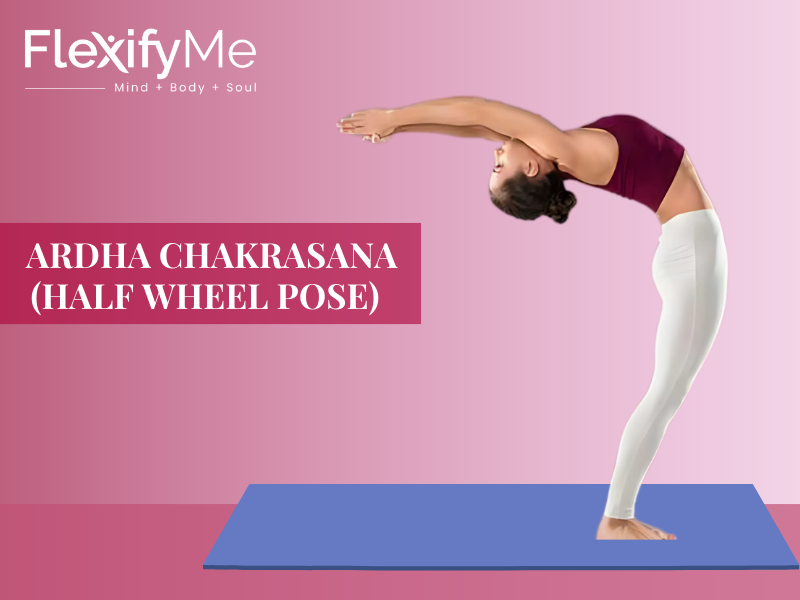
Ardha Chakrasana is also known as the half-wheel pose, a modified version of Chakrasana specifically for beginners, as the original pose requires considerable elasticity and strength. Let’s check out the steps.
1. First, stand with your spine straight, arms by your side, and feet slightly wide apart, balancing your weight equally on both.
2. Breathe in and extend your arms to the ceiling, palms facing each other. Or you can also place your arms on your butt muscles.
3. Now, breathe out gently, bend backwards, and push your buttocks forward, stretching your lower abdomen.
4. Slowly try to drop your neck down with your chest facing the ceiling.
5. Try to stay in the position for 5-6 breaths.
6. Lastly, come back to the normal position.
The Ardha Chakrasana is a beginner-level yoga asana with myriad benefits, including strengthening the spine, shoulders, and chest, increasing stability, and fostering mental well-being by reducing stress and anxiety. Therefore, it can be called a complete package.
Kati Chakrasana
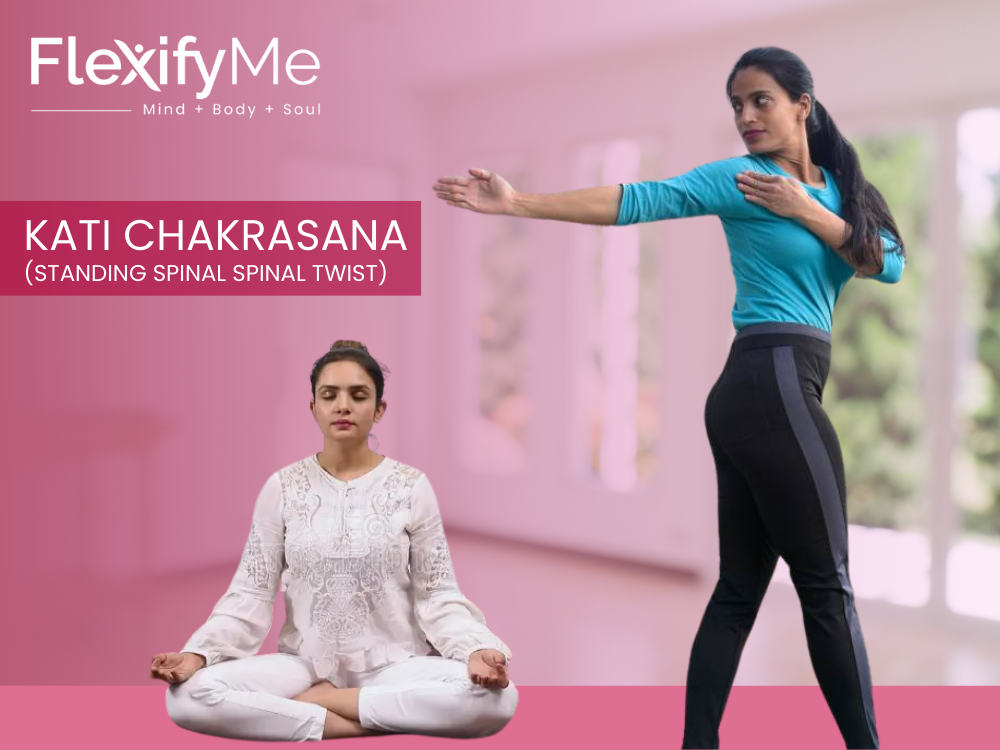
Kati Chakrasana, also known as the Standing Spinal Twist. It involves rotation of the waist, which gives a good stretch to the spine and waist,t particularly. The wheel pose strengthens muscles around the waist and spine. Here are the steps.
1. Stand straight vertically, with your feet hip-width apart, neck and shoulders aligned, and arm by your side.2. Inhale while raising your arms in front, parallel to the ground, palms facing each other, and fingers spread wide.
3. Exhale and slowly turn your upper body towards your right side from your waist, maintaining the distance between your palms.
4. Try to maintain the position for a few breaths.
5. Breathe in and come back to the starting position.
6. Breathe out and repeat the pose on your left side.
7. You can repeat this pose a few times, then relax by bringing your hands down.
The standing spinal twist pose enhances spine elasticity, improves digestion by relieving constipation, strengthens the core muscles, particularly in the waist region, corrects body posture, and relieves back pain. Furthermore, dynamic movement rejuvenates the complete body, elevating overall energy. The Kati Chakrasana is an easy pose and can be performed by anyone without any prior practice.
Purna Chakrasana
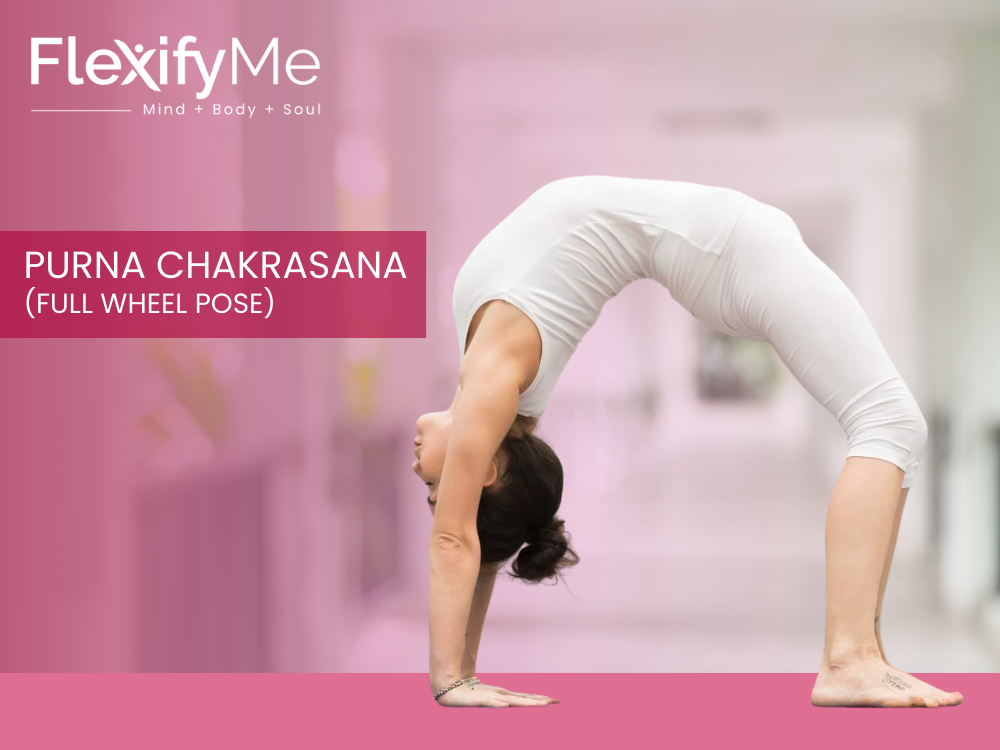
Purna Chakrasana, or full wheel pose, is an advanced form of Chakrasana where practitioners extend the pose by touching their feet, forming a complete wheel-like structure. Let’s check out the steps.
1. Lie on your back with your knees bent, feet firm on the floor, arms by your side, and palms facing the ground.
2. Now, slowly flip your palms, placing them near your shoulder by folding your elbows and putting your fingers facing your toes.
3. Press your feet and arms on the floor to engage your core muscles.
4. Inhale and lift your hips, raising your chest and back, making an arch.
5. Try straightening your arms and legs as much as you can, but do not force.
6. Now, carefully try to bring your palms closer to your feet. Or touch your feet if you can.
7. Breathe deeply while being in the pose for a few breaths.
8. To come out, gently move your palm away from your feet and bring your torso and hips back on the floor to the resting pose.
The Purna Chakrasana is a slightly more complicated and advanced pose than the regular Chakrasana. It requires a lot of practice to master this backbend yoga pose; therefore, it is advisable to perform it only when you are well-versed or under the guidance of a professional yoga tutor.
Start your wellness journey with expert-led online yoga classes from FlexifyMe. Join today and experience yoga from the comfort of your home!
Conclusion
The Chakrasana is a zestful pose with an advanced backbend that has numerous perks, including physical, psychological, and spiritual wellness. This pose has variations like Ardha Chakrasana, Kati Chakrasana, and Purna Chakrasana, the first two being a more straightforward version and the last one a more advanced version of this wheel pose. You can incorporate these modifications according to your level of flexibility and strength. By embracing this powerful pose, one can experience a significant transformation, embarking toward a peaceful, healthy, and spiritual life.
FAQs for Chakrasana (Wheel Pose)
1. What is Chakrasana, and what are its benefits?
A. Chakrasana is a backbend yoga asana where the body takes an arch shape. This backbend helps
- Improves spinal and shoulder flexibility and strengthens arms, legs, and back muscles.
- Strengthens the arms, legs, and back muscles.
- Improves breathing by expanding the chest.
- Stretches and energises the body.
2. Can beginners do Chakrasana safely?
A. Yes, Chakrasana can be safely done by beginners if they keep these things in mind:
- Learn it slowly with proper guidance.
- Warm up well and don’t force the body.
- Take support or props if needed.
3. How long can we hold the Wheel pose?
A. Beginners can hold the pose for about 10-30 seconds. Then gradually increase the duration once you’re comfortable.
4. What muscle group works during Chakrasana?
A. Chakrasana uses the back muscles, shoulders, triceps, chest and ribs. It also involves the hip flexors, glutes, abdominal muscles, thighs and calves.
5. What mistake should be avoided during Chakrasana?
A. Here are some common mistakes to avoid during Chakrasana.
- Forceful backbend without a warm-up.
- Putting too much pressure on the neck or lower back.
- Spreading the feet or hands too wide.
- Holding the breath during the pose.
- Locking the elbows or knees forcefully.
- Entering or exiting the pose too quickly.
6. Who must avoid the Wheel pose?
A. The wheel pose should be avoided by individuals who have:
- Back, neck, shoulder, or wrist injuries.
- High or low blood pressure.
- Heart conditions.
- Hernia or severe spinal problems.
- Dizziness or migraine issues.
7. What are the preparatory poses for Chakrasana?
A. Some preparatory poses for Chakrasana are Bhujangasana (Cobra Pose), Setu Bandhasana (Bridge Pose), Urdhva Mukha Svanasana (Upward Dog), Dhanurasana (Bow Pose), and Shoulder and wrist stretches.
8. What happens when we practice the Wheel pose daily?
A. When wheel pose is practised daily, it:
- Improves spinal flexibility and body posture.
- Build up the muscles in the back, shoulders, arms, and legs.
- Expands the chest and supports better breathing.
- Boost energy and reduce stiffness.
- Stimulates the nervous system and increases alertness.
- Enhances overall body balance and mobility.
9. Can Chakrasana help with weight loss and fitness?
A. Chakrasana supports overall fitness by strengthening muscles, improving flexibility, and increasing energy. However, for weight loss, it must be combined with other exercises and a balanced diet.
10. Does the wheel pose support back pain and posture correction?
A. The wheel pose helps improve the body posture and back muscles, which helps to reduce mild back pain.


