
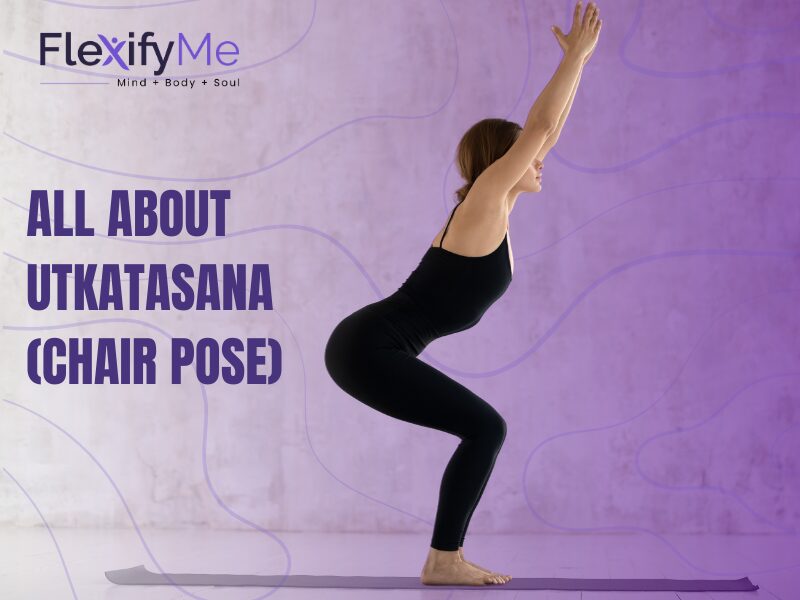

Utkatasana is one of those yoga poses that looks simple from across the room, only to immediately humble people the second they hold it for more than a few breaths.
At first glance, it seems straightforward. Bend the knees. Lift the arms. Sit the hips back a little. Done. But once you are in it, the pose starts introducing itself properly. The thighs wake up. The core has opinions. The shoulders join the conversation. And if the alignment is even slightly off, the pose becomes much harder than it needs to be.
That is part of what makes Chair Pose so useful.
It is not flashy. It is not a pose people usually post about because it looks dramatic. But it builds strength, stamina, and body awareness in a very honest way. Yoga Journal describes Chair Pose as a posture that demands strength and stamina in the body while also requiring focus in the breath and mind.
So yes, Utkatasana may look like “just sitting in an invisible chair,” but that description leaves out quite a lot.
What is Utkatasana (Chair Pose)?
Chair Pose, or Utkatasana in Sanskrit, looks deceptively simple. You’re essentially sitting on an invisible chair. But hold it for 30 seconds, and you’ll feel it in your quads, core, and shoulders all at once.
In this asana, you squat by bending your knees and drawing your hips back, then lift your arms overhead (or forward) and hold the posture by controlling your body and breath. It may seem simple, but it can feel surprisingly challenging to hold. The pose is known for building strength, teaching endurance, and improving focus.
Practised with proper alignment, it also helps improve posture and counteract the adverse effects of prolonged sitting.
How to Do Utkatasana (Chair Pose)?
Here is a step-by-step guide to practising Utkatasana safely and mindfully. Take your time to find balance, engage your muscles, and sync your movements with your breath.
Step 1: Set your starting position
- Stand upright with your feet either close together or spaced hip-width apart for better stability and comfort.
- Press evenly into your feet and engage your leg muscles, the quadriceps (front thighs), hamstrings (back thighs), glutes (buttocks), and calves.
- Feel grounded through your feet and lengthened through your spine. Imagine a string gently lifting the crown of your head towards the sky.
- Relax your shoulders away from your ears, and soften your face and throat.
Step 2: Prepare your arms and breath
- As you inhale, raise your arms overhead (or slightly forward if raising them fully is uncomfortable), with your palms facing each other or lightly touching.
- Gently engage your shoulder blades, and avoid letting your shoulders creep upwards.
- Keep your neck long and your gaze (drishti) forward or slightly upward to avoid straining your neck.
Step 3: Bend into Chair Pose
- As you exhale, bend your knees and move your hips back and down, as if you are about to sit in a chair behind you.
- Move your thighs parallel to the ground, as far as your strength and flexibility allow.
- Keep your knees aligned with your second or third toes. Don’t let your knees collapse inward or extend excessively beyond your toes.
- Keep your torso upright, or lean slightly forward if needed. Avoid collapsing your chest or over-arching your lower back.
- Gently point your tailbone downwards and engage your pelvic floor and lower abdominals to support your spine.
Step 4: Hold and refine the pose
- While holding the pose, keep your arms lifted, engage your core by drawing your belly slightly towards your spine, and press firmly through your heels to maintain strength in your legs.
- Keep your breath slow and steady. Inhale to lengthen your spine, and exhale to allow your hips to lower slightly further, if comfortable.
- Stay in the posture for as long as suits you. As a general guideline, beginners may hold the pose for 20–30 seconds, while more experienced practitioners can remain for 30–60 seconds or longer. Always gauge your personal comfort and alignment.
Step 5: Exit the pose safely
- As you exhale, slowly release the pose by straightening your legs and lowering your arms (if they were raised), returning to Mountain Pose.
- Take a moment to observe the effects of the posture, notice how your legs, hips, back, and arms feel.
Utkatasana Variations
This standing posture can be performed in different versions and variations to suit various practice levels, beginner, intermediate, or advanced, or to meet specific therapeutic or fitness goals.
Arms variation
- You can raise your arms overhead with palms facing each other, or turn your palms inward with your arms reaching parallel to the floor.
- To relieve shoulder strain, extend your arms forward at roughly shoulder height, with your palms facing down.
- For gentler options, you can place your hands lightly on your hips.
Wall/chair support
- If you are a beginner or experiencing balance or strength challenges, practise with your back against a wall for support.
- Another option is to sit on a block, chair, or even a lower surface to simulate the pose without full muscular engagement.
Deep variation/advanced version
- To increase the challenge, deepen the bend in your knees while maintaining safe alignment, and hold the pose for a longer duration.
- You may also hold light weights or small dumbbells overhead to increase engagement in your arms and shoulders.
Benefits of Utkatasana (Chair Pose)
When practised with proper alignment and breath awareness, Utkatasana offers a range of physical and mental benefits.
- Strengthens the lower-body musculature. The Chair Pose improves leg strength and endurance.
- Builds core and spinal support. Practising this standing pose encourages better posture and spinal stability.
- Stimulates cardiovascular endurance. Holding Chair Pose engages multiple large muscle groups at once, which can help build stamina and increase overall body endurance.
- Develops mental focus and breath awareness. This standing pose cultivates mental stamina, concentration and the ability to synchronise breath with movement.
- Promotes joint and bone health. When practised mindfully, Chair Pose also helps improve mobility in these joints.
Precautions in Chair Pose
While Utkatasana is suitable for many, there are a few necessary precautions that ensure a safe and beneficial practice.
- Warm up your legs, hips and back properly before practising Chair Pose, as cold muscles are more vulnerable to injury and strain.
- Keep knees aligned with toes. Avoid letting them track excessively beyond your toes as you bend, unless your body proportions safely allow it. Also, avoid the knees buckling inward or swaying sideways.
- Maintain a neutral spine and avoid excessive anterior pelvic tilt, which creates tension in the lower back. Engage your core to support the spine.
- Be mindful of weight distribution between your feet. Avoid placing too much weight exclusively on your toes or your heels. Ground through your heels while keeping your toes active to aid balance and stability.
- Avoid holding your breath. Focus on smooth inhalations and exhalations while holding the pose.
- Adjust for the shoulders. Lower your arms to shoulder height, or extend them forward at chest height if raising them overhead causes discomfort.
- Use props if needed. Practise with your back against a wall, or use a block to reduce the depth of the knee bend while your body acclimatises. These modifications are helpful for beginners or those with knee or other joint sensitivities.
- Stop if dizziness occurs or if you feel unstable at any point. Gently come out of the pose and rest.
You can reduce the risk of strain or injury and maximise the benefits by being mindful of your alignment and attentive to your body’s current state.
Contraindications of Utkatasana (Chair Pose)
There are certain conditions in which practitioners should adapt the Chair Pose or avoid it altogether. If any of the following apply to you, consult a qualified yoga instructor or healthcare professional for suitable modifications.
Knee pain or recent knee injury
Because this pose places load on bent knees, it may aggravate existing knee issues.
Lower-back issues or slipped/herniated disc
If you have an unstable lumbar spine condition, take care in this pose, as deep knee bending can strain your lower back. You may prefer a more upright variation or avoid the movement altogether.
Hip or ankle injury or surgery
The hips and ankles play a stabilising role in this pose; therefore, if you are recovering from surgery or a major injury in these joints, consider modifying or avoiding the pose.
Severe arthritis (especially in the knees or hips)
Practice with caution under supervision. You should start with less depth, use props, or avoid the pose entirely.
Pregnancy (especially in the second or third trimester)
While some pregnant practitioners can perform a modified version of Chair Pose, it is essential to use an adapted stance (wider feet, gentler thigh engagement, supports, etc.) to avoid further strain.
Low blood pressure, dizziness, or faintness
As this pose can be physically demanding and involves raised arms (which may affect blood flow), practitioners with hypotension should use caution and avoid holding the full extension for too long.
Headaches, vertigo, or inner-ear issues
If balance problems or dizziness occur while practising this pose, movements such as raising the arms or bending deeply can aggravate symptoms, so practitioners should proceed with caution.
Note: It is important to modify the pose (reduce depth, adjust arm position, or use support) or stop it until it feels safe. Always listen to your body and consult a professional if needed.
Join our Online Yoga Classes and get 1 Free Demo Session with expert trainers who guide you step-by-step from comfort of your home.
Final Thoughts: Making Utkatasana Work for You
Chair Pose, or Utkatasana, is a highly transformative pose in the yoga tradition.
The benefits are wide-ranging when the pose is practised with proper alignment and attention. From stronger legs and core to improved balance, stability, and posture, the benefits are worth the effort.
Whether you are a beginner trying your first standing pose or an experienced practitioner exploring deeper variations, listening to your body goes a long way. Tune in to your body’s signals, modify when needed, establish an appropriate warm-up, and take time to find your comfortable depth.
Integrate this standing pose into your regular yoga practice. In time, you will likely notice stronger thighs, a firmer core, improved posture, and a calmer, steadier mind.
More than merely holding a position, chair pose can be a moment of empowerment.
Frequently Asked Questions About Chair Pose
1. What is Utkatasana?
A. Utkatasana is a yoga pose in which the body looks like you are sitting on a chair. That’s why it’s also known as Chair Pose.
2. What are the types or variations of Utkatasana (Chair Pose)?
A. Some variations of Chair Pose are:
- Revolved Chair Pose: This adds a spinal twist to engage the core.
- One-Legged Chair Pose: It challenges balance and strengthens the standing leg.
- Toe Stand Chair Pose: Here, the heels are lifted to engage the calves and ankles.
- Prayer Chair Pose: For this variation, hands are brought to the heart in prayer position to increase focus and stability.
3. What are the advantages of Utkatasana?
A. Utkatasana offers several mental and physical benefits, such as.
- Strengthening the thighs, calves, ankles, core, and back muscles.
- Toning the muscles in the legs, glutes, shoulders, and chest.
- Improving body balance, posture and concentration.
4. How to perform the Chair Pose properly?
A. Here’s how to practice the Chair Pose correctly.
- Stand straight with your feet together.
- Inhale and raise your hands overhead with your palms facing inward.
- Exhale, bend your knees and push your hips back as if you are sitting in a chair.
- Keep your chest open, back straight, and weight balanced on your feet.
- Hold the pose, breathing steadily, and keep your knees aligned with your toes.
5. What muscles are worked in Utkatasana?
A. Utkatasana uses the thighs, quadriceps, glutes, calves, and core muscles. It also engages the shoulders and arms.
6. What are the common mistakes to avoid in Utkatasana?
A. Some of the common mistakes to avoid are extending your knees too far, rounding your back, and bending your chest forward. Some people also lean on one foot rather than distribute their weight on both feet.
7. Is it safe for beginners to do Chair Pose?
A. Yes, beginners can practice Chair Pose safely with proper care. They can start by bending their knees slightly instead of sitting too deeply. Using a wall for support is a great option for beginners. Apart from that, practising under the guidance of a yoga instructor will also ensure safety.
8. Who should avoid Chair Pose?
A. Chair Pose must be avoided by people with:
- Knee injuries or chronic knee pain
- Lower back problems, such as sciatica or chronic lower back pain
- Low blood pressure or dizziness
- Ankle problem or injury
- Heart conditions.
Additionally, compression in the stomach during pregnancy can be dangerous, so it is highly recommended to do the Chair Pose under proper guidance.
9. Is Utkatasana good for weight loss or fat burning?
A. It can help the weight loss process. But remember, it is not a high-calorie-burning exercise, so you have to combine it with some other exercises to burn fat effectively.
10. Can Utkatasana relieve back pain or posture issues?
A. Utkatasana helps improve posture and support the spine. It strengthens the core, thighs, and lower back muscles, which can improve posture and reduce mild stiffness from poor sitting habits.
11. For how long should I hold Utkatasana for best results?
A. Utkatasana can be held for about 20 to 60 seconds, depending on your strength and experience. Start by holding for 10-20 seconds, then slowly increase the duration.
12. How often should I practice Chair Pose?
A. Chair Pose can be practised 3-5 days a week. Beginners can start holding for 20–30 seconds, 2–3 rounds. Once you’re comfortable, extend it to 45–60 second holds.
13. What is the meaning of the word ‘Utkatasana’?
A. Utkatasana means powerful chair pose. “Ut” means powerful, “kata” means chair and “asana” means pose or posture.
14. Is Utkatasana suitable during pregnancy?
A. Utkatasana yoga can be suitable during early pregnancy only if you’ve been practising it earlier. However, in the later stages, it is better to avoid it due to changes in balance, abdominal pressure, and lower back strain. However, if you want to practice during pregnancy, you must consult your doctor or a prenatal yoga instructor.
15. Can I include Utkatasana in my daily yoga routine?
A. Yes, this standing pose can be included in your daily routine if you do it in the right way. But always remember to do it moderately and not intensely. Overdoing it can strain your knees or lower back.