


Yoga is a traditional practice that balances both mind and body thyroid problems. Through gentle movement, mindful breathing and relaxation, yoga revives the body’s natural healing and promotes overall health. With regular practice, yogasanas help the body function more efficiently, improve natural rhythms and overall energy.
One of the best things about yoga is its ability to influence the body’s internal system through controlled breathing and systematic poses. In fact, many studies show that regular yoga can improve stress levels, mood and even markers like TSH (thyroid-stimulating hormone), which play a key role in thyroid activity.
In this guide, we’ve highlighted some specific yogasanas that are safe, accessible and adaptable for all levels. Integrating these practices along with medication can help you restore your thyroid health.
Understanding Thyroid Disorders (Hypothyroidism vs Hyperthyroidism)
The thyroid is a tiny butterfly-shaped organ located in the neck. Though small, it plays a big role in how our body functions. It controls metabolism, energy levels, body temperature and even mood by releasing thyroid hormones. When this hormone is produced too little or too much, it can lead to thyroid disorders.
Hypothyroidism occurs when the thyroid gland does not produce enough hormones. It is one of the most common thyroid disorders and often develops slowly. People with this condition often feel tired, sluggish, or cold and may experience weight gain, dry skin, hair thinning or low mood.
Hyperthyroidism happens when the thyroid produces excessive hormones. It speeds up the body’s systems, causing symptoms like rapid heartbeat, anxiety, weight loss, heat intolerance and restlessness. Some people may also feel irritated or have trouble sleeping.
Can Yoga Really Help Manage Thyroid Problems?
Yoga is not a cure for thyroid disorders, but research and real-life experience suggest that it can be a helpful practice. Yoga does not directly work on the thyroid, but it helps calm the nervous system and reduce stress. Since stress is known to affect hormone regulation, this pacifying effect alone can bring noticeable differences for people dealing with thyroid issues.
Some yoga poses gently stretch and stimulate the neck and throat area, where the thyroid gland is located. These movements help improve blood flow and encourage healthier gland function over time. Additionally, breathing practices and relaxation techniques used in yoga help lower cortisol levels, supporting better hormonal balance and energy regulation.
However, it is important to understand that yoga works better when practised habitually with medical treatment. Over time, it has proved to be a powerful tool for improving both physical and mental health for thyroid patients.
Can Yoga Cure Thyroid Permanently? (Medical Reality)
Yoga offers a well-rounded approach to managing health conditions and reducing the risk of further complications. In thyroid conditions, yoga may not provide a permanent cure, but it can help prevent symptoms from worsening.
With early diagnosis, positive lifestyle changes and regular yogic practice, hypothyroidism can often be better managed, and in some cases, symptoms may improve significantly over time.
Yoga asanas and certain neck exercises support optimal functioning of the thyroid gland.
Yoga Asanas for Hypothyroidism
Yoga asanas for hypothyroidism focus on gently stimulating the thyroid gland, improving circulation, and boosting overall energy levels. Here are some poses that help in the healthy functioning of the thyroid gland.
1. Halasana (Plow Pose) for Hypothyroidism
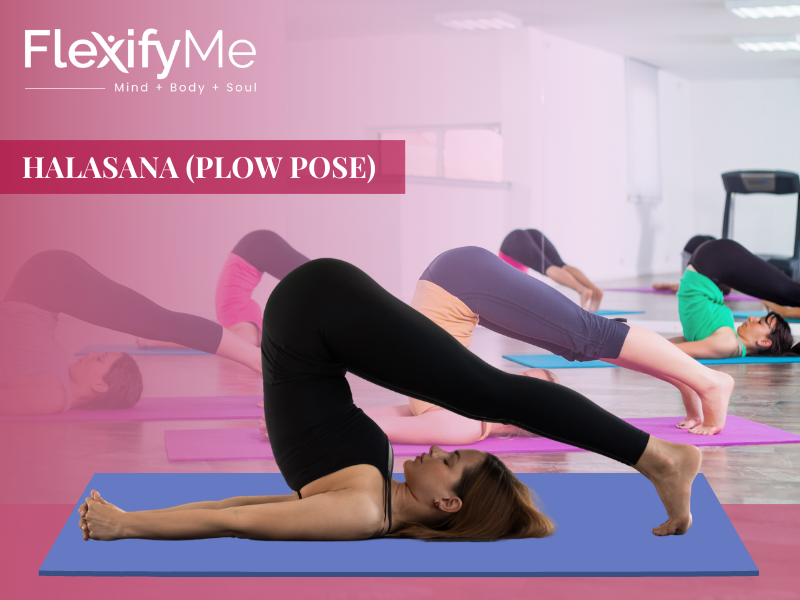
Halasana creates a gentle but deep stretch in the neck and throat area, where the thyroid gland is located. Here’s how to practice it.
- Lie down flat on your back with your legs together and arms resting by your side.
- Inhale and slowly lift both legs to a 90-degree angle.
- Exhale and gently raise your hips, bringing your legs over your head.
- Try to place your toes on the floor behind your head while keeping your legs straight.
- You can support your lower back with your hands or keep them flat on the floor.
- Hold the pose for 15-30 seconds while breathing normally.
- Slowly release by lowering your back and legs down one at a time.
2.Matsyasana (Fish Pose) for Hypothyroidism
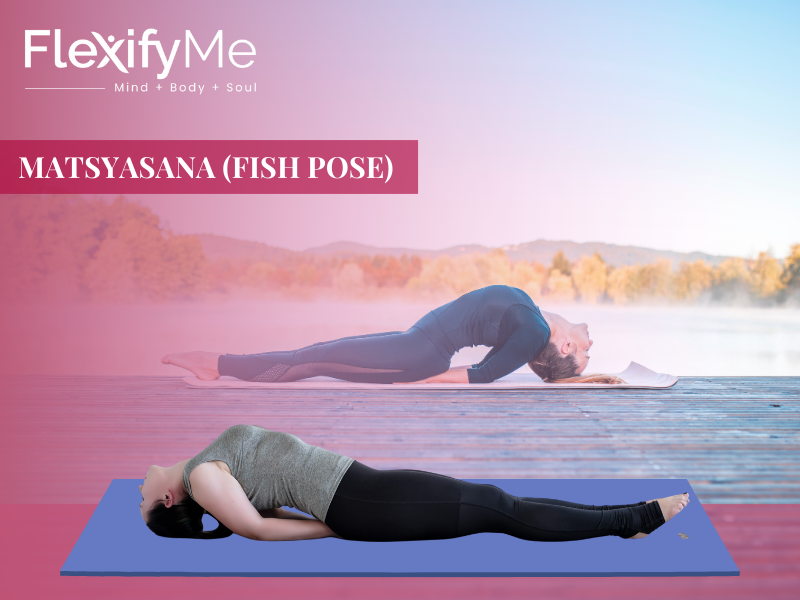
Matsyasana creates a deep stretch in the throat and neck region, directly stimulating the thyroid gland. Here are the steps:
- Lie on your back with your legs stretched out and your arms relaxed by your sides.
- Slide your hands under your hips, palms facing down.
- Now inhale and slowly lift your chest upward while arching your back.
- Slowly lower the crown of your head towards the floor, keeping most of the weight on your elbows and forearms.
- Keep your chest open and throat stretched, breathing normally.
- Hold the pose for 15-30 seconds.
- To release, lift your head slightly, lower your chest and relax back into a lying position.
3.Bhujangasana (Cobra Pose) for Hypothyroidism
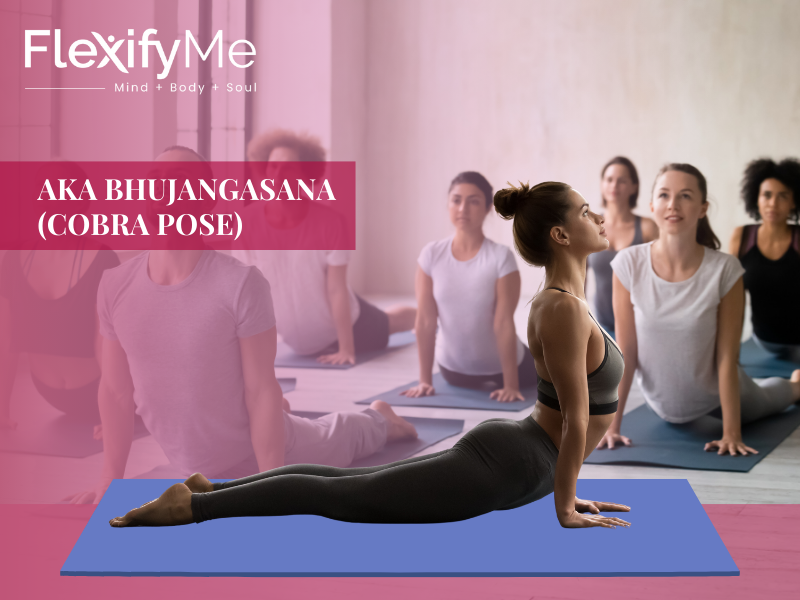
Bhujangasana gently stretches the neck and throat area, making it a supportive asana for managing hypothyroidism when practised regularly. Let’s check the steps:
- Lie on your stomach with your legs extended.
- Set your palms under your shoulders with your elbows kept close to your sides.
- Inhale, then slowly push through your hands to lift your chest off the floor.
- Keep your lower body and pelvis on the ground while arching your spine.
- Lift your head and look slightly upward, keeping the neck relaxed.
- Hold the pose for 15-30 seconds.
- Exhale and slowly lower your chest back to the floor.
4.Sarvangasana (Shoulder Stand) for Hypothyroidism
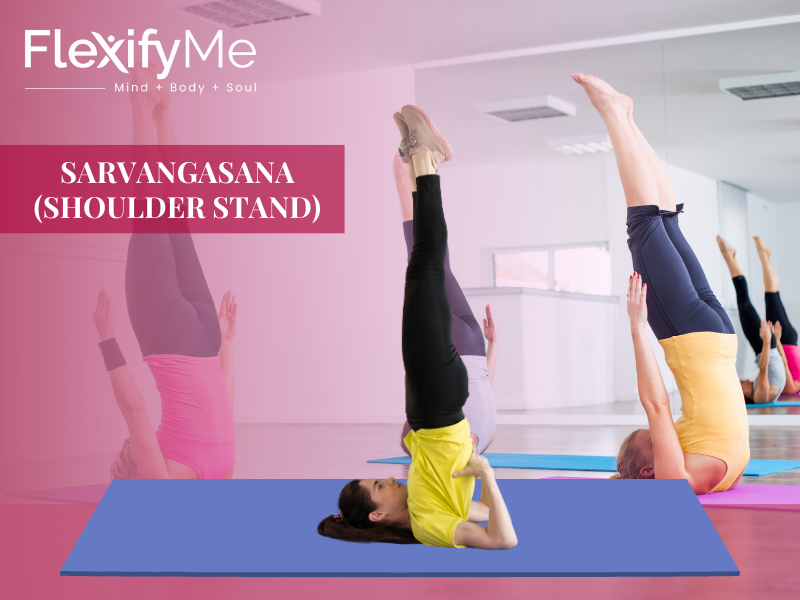
Sarvangasana is often called the “queen of asanas” because of its powerful effect on the endocrine system. The steps are as follows:
- Lie flat on your back with your legs together and arms by your sides.
- Inhale and slowly lift your legs to a 90-degree angle.
- Exhale and raise your hips, supporting your lower back with your hands.
- Straighten your legs upwards so your body forms a straight line from shoulders to toes.
- Keep your elbows close together and your chin gently resting on your chest.
- Hold the pose for 15-30 seconds.
- To release, slowly lower your legs and back to the floor with control.
Yoga Asanas for Hyperthyroidism
Unlike hypothyroidism, hyperthyroidism requires a soothing and grounding yoga approach. These asanas help calm the mind, ease tension and restore balance without overstimulating the thyroid gland.
1.Setu Bandhasana (Bridge Pose) for Hyperthyroidism
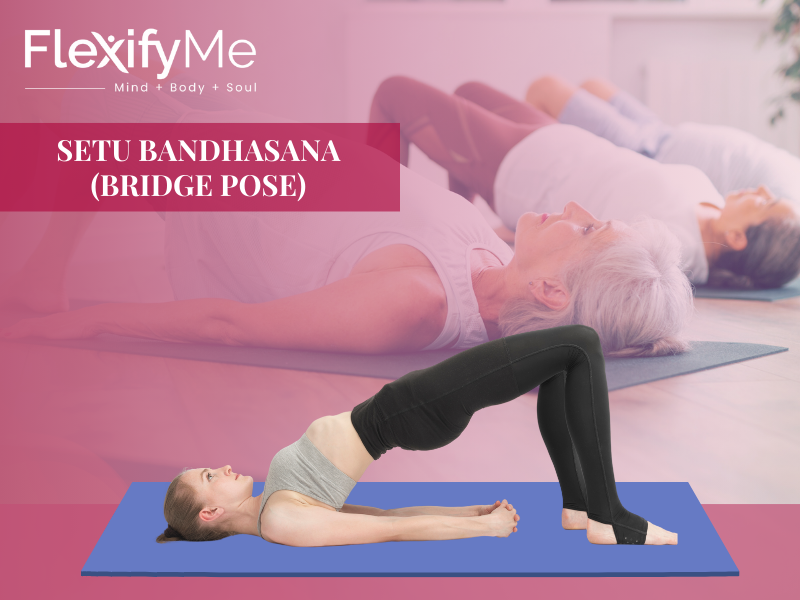
Setu Bandhasana provides a gentle stretch to the neck and chest without putting excessive pressure on the thyroid gland. Let’s check out the steps.
- Lie down on your back with your legs folded and your soles resting on the floor.
- Place your arms alongside your body with palms facing down.
- Now breathe in and slowly lift your hips upward, pressing your feet and arms into the floor.
- Keep your thighs parallel and gently open your chest without straining your neck.
- Hold the pose for 15-30 seconds while breathing slowly and evenly.
- Exhale and gently lower your hips back to the floor.
2. Shavasana (Corpse Pose) for Hyperthyroidism
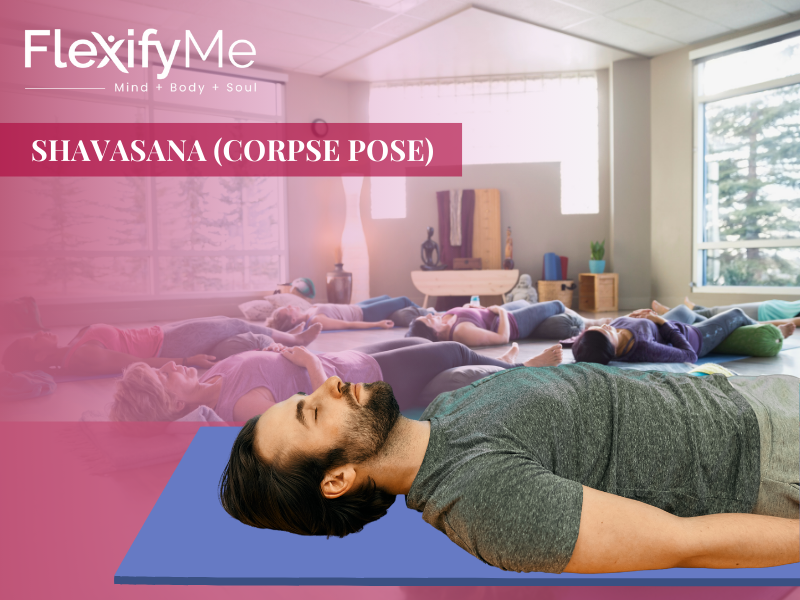
Shavasana is one of the most effective poses for calming an overactive nervous system, which is especially important for hyperthyroidism. Here are the steps:
- Lie flat on your back with your legs slightly apart and arms relaxed by your sides, palms facing upward.
- Close your eyes and take a few deep breaths, allowing your body to settle into the floor. \
- Relax every part of your body from head to toe.
- Stay in this position for 5-10 minutes, breathing slowly.
- To come out, gently move your fingers and toes, roll to one side and sit up.
3.Balasana (Child’s Pose) for Hyperthyroidism
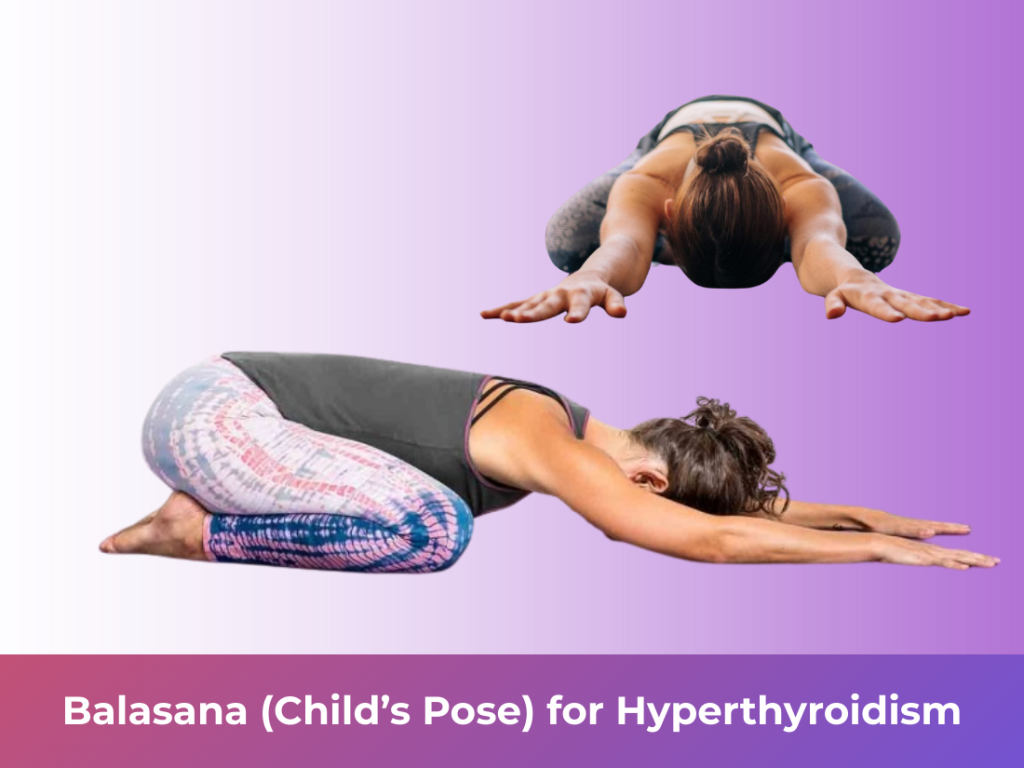
Balasana is a deeply calming pose that helps soothe an overactive nervous system, which is common in hyperthyroidism. Let’s see how to practice it.
- On the floor, kneel with your toes together and your knees comfortably apart.
- Sit back on your heels and slowly fold your torso forward, bringing your forehead to the floor.
- Extend your arms forward with palms down or keep them alongside your body.
- Breathe slowly, allowing your back, shoulders, and neck to relax completely.
- Stay in the pose for 1-5 minutes, or more if comfortable.
- To come out of the pose, slowly lift your body and return to the starting position.
Pranayama for Thyroid Health
Pranayama can be a powerful tool to support thyroid health. Some commonly recommended pranaya techniques for the thyroid are:
Bhramari (Bee Breathe)

Here, a gentle humming sound quiets the mind, eases anxiety and soothes the nervous system.
Ujjayi (Ocean Breathe)

It encourages slow, deep breathing that improves circulation and energy flow.
Sheetali and Sheetkari (Cooling Breaths)

These pranayamas help reduce excess heat and restlessness in the body.
Nadi Shodhana (Alternate Nostril Breathing)

This breathing exercise balances the two sides of the brain and supports overall endocrine function.
Note: Pranayama should be practised on an empty stomach, in a comfortable seated position, and with awareness of the breath.
Yoga Mudras for Thyroid Support
Yoga mudras are simple hand gestures that help direct energy flow in the body. They also stimulate internal organs, including the thyroid gland. Some mudras, when combined with posture and pranayama, provide a healing effect on the body. Some mudras helpful for thyroid health are.
- Gyan Mudra (Knowledge Gesture): Formed by touching the tip of your index finger to the thumb while keeping the other fingers straight.
- Prithvi Mudra (Earth Gesture): Created by touching the tip of the ring finger to the thumb.
- Varun Mudra (Water Gesture): Formed by touching the tip of your little finger with your thumb.
Safety, Contraindications & Who Should Avoid Certain Poses
While yoga can be very beneficial for thyroid health, it is important to practice with awareness and respect your body’s limits. Certain poses, like Sarvangasana (Shoulder Stand) or Bhujangasana (Cobra Pose), may not be suitable for everyone. Also, incorrect alignment or overdoing can strain the neck, spine or heart, particularly if there are existing health issues.
Safety Tips for Thyroid Yoga
- Practice yoga on an empty stomach or at least 2-3 hours after food.
- Move slowly and carefully, and do not force your body.
- Combine asanas with breathing exercises and mudras.
- If you have thyroid or any other health conditions, consult your family doctor before starting a new yoga routine.
Who Should Be Cautious
- People with neck, shoulder or spinal injuries should avoid deep bends.
- People with high blood pressure, heart problems or glaucoma should consult a doctor before practising inversions like Sarvangasana or Halasana.
- Beginners should always use props or modifications to prevent strain.
- Pregnant women must avoid deep twists, strong backbends and inversions.
Can I Do Yoga Along With Thyroid Medication?
Yes, yoga, along with thyroid medication, is often recommended. However, it should not replace prescribed treatment. Yoga is a supportive tool that helps reduce stress, improve circulation, and gently stimulate the thyroid, while medication manages hormone levels. When yoga is combined with medical care, it can complement treatment, helping you feel more energised and in control of your thyroid health.
How Often Should You Practice Yoga for Thyroid Health?
For performing yoga, the most important thing is consistency. Practising yoga 5-6 days a week for 20-40 minutes can benefit the thyroid and overall health. Beginners can start with 10-15 minutes daily and slowly increase time with practice.
Start your personalised online yoga program for thyroid care today – practise safely with expert guidance and support your thyroid health from home.
Final Thoughts – Yoga as Supportive Therapy for Thyroid
Yoga can be a powerful way to support thyroid disorders and overall well-being. Whether you’re dealing with hypothyroidism or hyperthyroidism, yoga has proven benefits in both cases. Various asanas, including Halasana, Matsyasana, Shavasana, and Balasana, help manage thyroid alongside medication. When practised regularly with proper precautions, yoga can be a great ally in managing thyroid health.
Frequently Asked Questions Best Yoga Asanas for Thyroid Problems
1. Which yoga asanas are most effective for managing thyroid problems?
There is no single best yoga asana for everyone with thyroid problems, as the suitable poses depend on whether the condition is hypothyroidism or hyperthyroidism. However, commonly recommended poses such as Sarvangasana, Matsyasana and Bhujangasana are known to gently stimulate the neck and throat region and support healthy blood circulation when practiced correctly and under professional guidance.
2. Can yoga permanently cure thyroid disorders?
Yoga cannot permanently cure thyroid disorders such as hypothyroidism or hyperthyroidism. However, regular and guided yoga practice can help manage symptoms, reduce stress, improve overall well-being and support healthy thyroid function. Yoga should always be used as a supportive therapy along with medical treatment prescribed by your doctor.
3. Can yoga help improve thyroid hormone levels or TSH naturally?
Yoga may help support healthy thyroid hormone balance by reducing stress, improving circulation and supporting the body’s hormonal regulation. While some people notice improvements in well-being and energy levels, yoga should not be considered a medical treatment for correcting abnormal TSH or hormone levels without proper medical care.
4. Is it safe to practice Sarvangasana if I have a thyroid problem?
Sarvangasana may be helpful for some people with thyroid disorders, but it is not suitable for everyone. People with neck pain, cervical spine issues, high blood pressure, vertigo, glaucoma or recent surgery should avoid this posture or perform it only under the supervision of a qualified yoga therapist or physiotherapist.
5. How often should yoga be practiced to support thyroid health?
For most people with thyroid problems, practicing yoga about four to five times per week for 30 to 45 minutes can be beneficial. A consistent and gentle routine focused on proper alignment and breathing is more important than performing advanced or intense postures.
6. Which pranayama is considered helpful for people with thyroid problems?
Gentle breathing practices such as Anulom Vilom, Bhramari and Ujjayi pranayama are commonly recommended for people with thyroid disorders. These techniques help reduce stress and support the nervous system, which plays an important role in overall hormonal health.
7. Can beginners with thyroid problems safely start yoga at home?
Beginners with thyroid problems can start yoga safely if they choose gentle poses, avoid strong neck strain and follow proper guidance from a qualified yoga instructor or physiotherapist. Starting slowly and focusing on correct posture and breathing is essential to prevent discomfort or injury.
8. Can yoga help with weight gain and fatigue caused by thyroid problems?
Yoga can support weight management and reduce fatigue by improving physical activity levels, reducing stress and supporting metabolic health. However, thyroid-related weight changes and persistent fatigue should always be managed together with appropriate medical treatment and dietary guidance.
9. Is it safe to practice yoga while taking thyroid medication?
Yes, yoga can be safely practiced while taking thyroid medication. Yoga should be used as a complementary approach and not as a replacement for prescribed treatment. Always continue your medication as advised by your doctor and consult your healthcare provider before making any changes.
10. Can yoga help reduce neck stiffness and body pain related to thyroid problems?
Yes, gentle yoga and therapeutic exercises can help improve neck mobility, reduce shoulder stiffness and relieve general body discomfort that may be associated with thyroid conditions. A physiotherapy-guided approach can further help improve posture and prevent strain while practicing yoga.